
Searching Shannon County Criminal Dockets
A Shannon County criminal docket search starts with the statewide Case.net public search. That portal is the entry point for every county. It lets you search by litigant name, case number, filing date, or scheduled hearings and trials. The case number is your best bet. Use it when a citation, notice, complaint, or an old docket printout gives you one. A name search is the weaker tool. It returns only people listed as litigants. Victims, witnesses, and children named in a case file will not appear. Filing-date and hearing searches take practice. They work best when you already know the division and a narrow date range.
Before opening a Shannon County result, check the case number, division, filing date, and case style. Open it then. Read the full result through the Case Header view and again through the Docket Entry view. The case header gives the summary. The docket entries tell the story in order. Every filing, hearing, and court action lands there by date. Keep in mind that a public Shannon County result can be incomplete. A missing result never proves a criminal case did not exist.
- Open Case.net for a Shannon County case and choose the search mode that fits the information in hand.
- Enter the exact case number for the Shannon County matter when known, or use a litigant name, filing date, or scheduled-hearing search.
- Compare the returned Shannon County case number, division, filing date, and style before selecting a result.
- Review the Shannon County Case Header and Docket Entry, recording the event date and document title needed for a clerk follow-up.
- Ask the Shannon County Circuit Clerk about a certified copy, unavailable document, or access restriction rather than relying on a screen image.
Note: Case.net is a Missouri state-court tool for Shannon County searches. It is not a federal-case database or a full archive of historic paper files.
Shannon County Criminal Court Rhythm
The 37th Judicial Circuit local rules set the schedule. Shannon County Division II criminal court sits on the first and third Tuesday following the first Monday at 9:00 a.m. Those are regular court days. The rules do not promise that any particular matter will be called, resolved, or heard. For the actual setting, the case-specific docket entry is still the best source.
Division I law days run on the second and fourth Monday at 1:00 p.m. They cover arraignments, guilty pleas, probation violations, and consent matters. Prisoner arraignments and miscellaneous criminal matters appear Tuesday, Thursday, and Friday at 8:30 a.m. This explains the odd mismatch. A Shannon County docket may list a time that does not match the Division II schedule.
Calendar check: A Shannon County recurring court day is a planning reference. Check the individual docket and confirm with the clerk before appearing for a criminal hearing.
Inside a Shannon County Criminal Docket
Start with the criminal complaint. A Shannon County filing header can carry a lot. It may show the court, party roles, case number, OCN, filing date, a clerk notation, the complaint title, charge code, statute, and classification. After that, the Shannon County docket picks up the story. It records case activity as it happens. Not every field shows up for every viewer, since access level controls what appears. So if a field is missing from a docket entry, that gap alone doesn't prove it was never created.
| Shannon County case identification | Case number, court, party roles, OCN, filing date, and clerk notation may identify the matter. |
|---|---|
| Shannon County charge information | A charge code, statute citation, and classification can describe an allegation made in a filing. They do not by themselves establish a conviction. |
| Shannon County opening events | Filing, summons or warrant, and arraignment entries show steps that may occur near the start of a case. |
| Shannon County case management | Counsel entries, motions, plea activity, continuances, and hearing settings show how the matter moves. |
| Shannon County later entries | Sentencing, probation, a disposition, payment, or compliance entries may appear after a later court action. |
An official Shannon County criminal complaint shows what a filing header can hold: court, party roles, case number, OCN, filing date, clerk notation, complaint title, charge code, statute, and classification. The docket then tracks later activity in the case. Which fields appear depends on your access level, so a missing field does not mean it was never created.
A Shannon County Criminal Case Number
An official Missouri Attorney General filing supplies the Shannon County criminal example 25AN-CR00305. Treat it as one example. It is not a decoder for every case. Case type, filing year, and court record in the county can all differ. The visible parts hint at a two-digit year, a Shannon County code, a criminal segment, and a sequence. Always enter a case number exactly as printed.
- 25
- The observed Shannon County filing-year prefix in this one example.
- AN
- An apparent Shannon County local code in the observed filing, not a guarantee for every record.
- CR
- The criminal case-type segment shown in the Shannon County example.
- 00305
- The five-digit sequence displayed in that Shannon County filing.
When an exact number returns nothing, recheck the punctuation and characters against the paper notice. The Shannon County Circuit Clerk can point you to the right search path. Keep in mind that a missing match may simply reflect a filing date, restricted access, or a record outside the public remote view.
How a Criminal Case Moves
A Shannon County criminal docket often opens with a filing, then shows a summons or warrant, an arraignment, counsel activity, motions, and later settings. From there it may record a plea or trial, then a disposition, sentencing, probation, or a compliance event. No two cases follow the same path. A continuance shifts a setting without deciding the charge.
Docket flow: Filing → Summons or Warrant → Arraignment → Counsel and Motions → Plea or Trial → Disposition → Sentencing or Probation
The distinction matters when you read a Shannon County record. A complaint is an accusation in a court filing. A conviction is a separate legal result, and it should never be assumed from a complaint, an arrest reference, or an early docket line. A disposition may answer what happened to a charge. Later entries can record a payment or a probation-related obligation.
Historic Shannon Criminal Docket Volume
The Missouri FY2014 Judicial Supplement offers a historical picture. It is not a current count, and it covers Shannon County's criminal workload. It lists 49 felony cases filed, 50 disposed, and 33 pending. Shannon County associate felony cases show 122 filed, 120 disposed, and 94 pending. Misdemeanors came in at 391 filed, 482 disposed, and 753 pending.
The Shannon County numbers here reflect one fiscal year, July 1 through June 30. That span is historical. They say nothing about today's criminal docket volume, current delays, or where any one Shannon County case now stands.
Courts That Hold Criminal Dockets
Shannon County sits in Missouri’s 37th Judicial Circuit. Under the local rules, Division II handles criminal days. Division I runs separate law-day settings. So the same Shannon County criminal docket can carry different division labels and hearing times depending on where the case landed. When Case.net shows a case, trust the court name, division, and exact case number listed there. A guess based on offense level or a county label alone can lead you wrong.
The official Missouri directory lists the Shannon Circuit Clerk and Recorder as the contact. That office handles judicial records there. County administrative files and County Commission records live with the County Clerk instead. That is a separate collection entirely. A municipal matter may run through its own city process or a Division II arrangement. Federal charges never appear in Missouri Case.net. Those cases go through the federal courts and PACER.
Note: A court name or docket location tells you where a case is handled. It says nothing about whether an allegation has been proved.
Shannon County Criminal Docket Terms
A short docket line can invite overreading. Plain terms help. A filing puts a document or charge before the court. An arraignment is a court appearance tied to the charge. A continuance simply moves a setting to a new date. A disposition records the result on a count or case, and a sentencing entry covers the penalty phase when one applies.
- Charge
- An accusation stated in a case record; it is not a finding of guilt.
- Complaint
- A filed document that can state allegations and initiate or support a criminal case.
- Disposition
- A docketed result or resolution, which must be read for its exact wording.
- Conviction
- A legal outcome that should be confirmed from the court’s recorded disposition, not inferred from an accusation.
When you ask the clerk about a document, use the entry title exactly as written in the docket. Quoting the court’s own record beats offering a general label that may match several filings.
Sealed Dockets and Public Access
Public access to a Shannon criminal docket has limits. Not every filing is open to everyone. Missouri court records operate under court-access rules, including Court Operating Rule 2. Remote access from home can be narrower. A public terminal inside the courthouse may show more. A case may be visible while one of its attachments stays restricted. And a search that returns nothing does not prove the case does not exist.
Access limits:
RSMo §211.321 places special limits on juvenile and social records.
RSMo §610.140 governs expungement; an expunged record is not a normal public criminal-search result.
Missouri File Viewer guidance explains that a linked docket entry can open a permitted document, while a non-linked entry may have no attachment or insufficient access.
The image below comes from the official expungement statute.
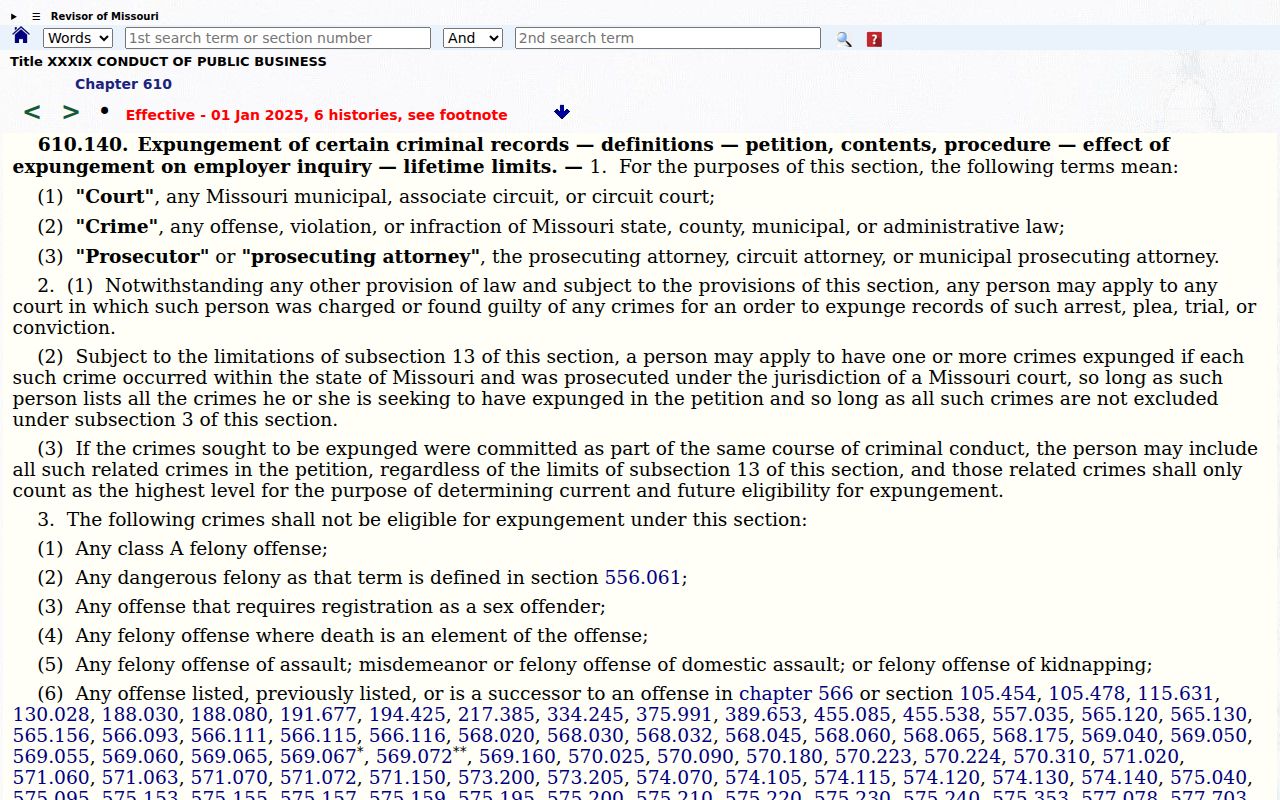
Expungement seals a Shannon County case from public view. So a missing docket search result means nothing about what happened before.
When Criminal Document Links Fail
A docket entry and the document behind it are two different things. The File Viewer help page explains the gap. A hyperlinked entry may open the attached document when public permission allows. An entry with no link is murkier. Maybe nothing was attached, or maybe the public user simply lacks access. Either way, it does not mean the event is false or that the court holds no record of it.
Need the document itself? Write down the case number, the docket-entry date, and the exact entry description. Then ask the Circuit Clerk whether a courthouse public terminal, an ordinary copy, or a certified copy is available, and confirm the copy fee, delivery method, and turnaround time with that office.
For sealed juvenile matters, the official juvenile-record confidentiality statute sets out what the law protects.
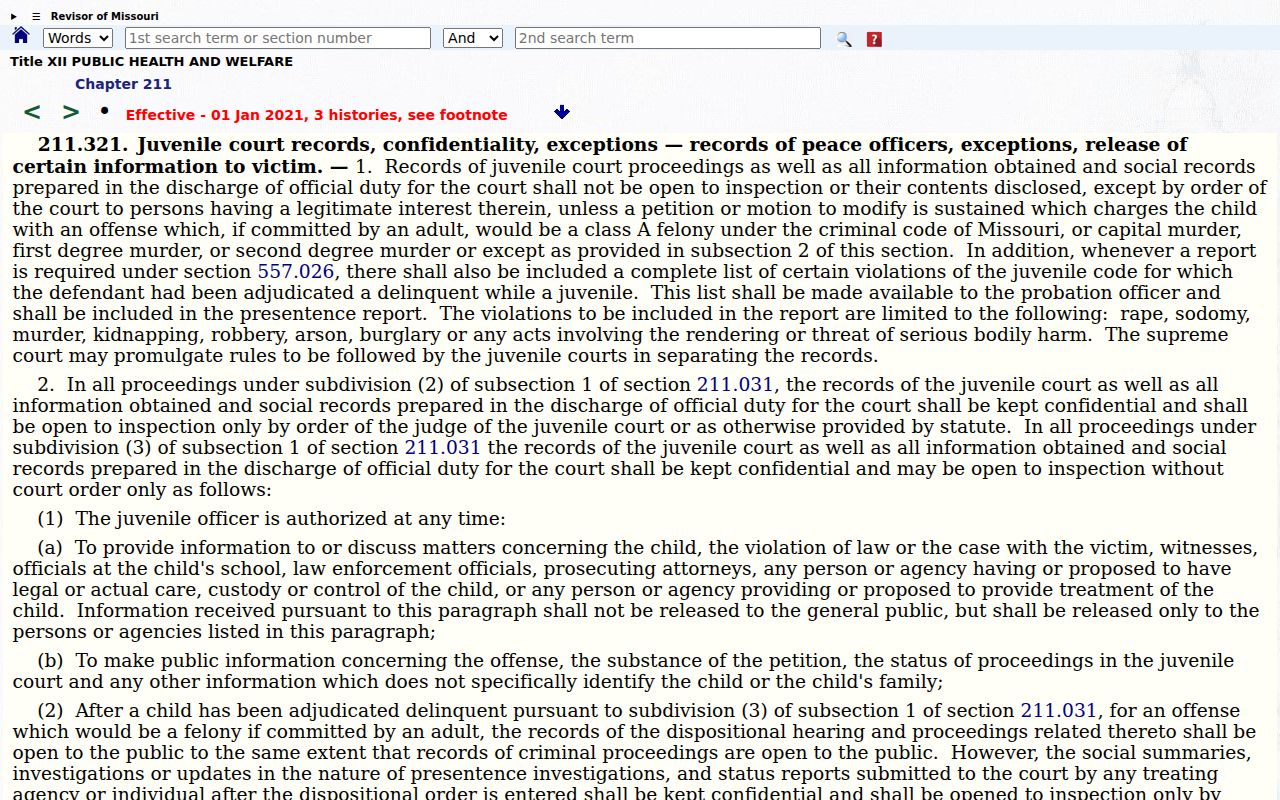
Even where local rules list a regular juvenile court day, the juvenile record itself can stay restricted.